

Stock exchange compliance and investor relations in practice
The operation of the capital market, both domestically and internationally, takes place within a robust regulatory and communication environment, in which not only companies but also investors are active participants. The case of the Delta Group (formerly Delta Technologies) is particularly instructive, as, being one of the few listed companies in the domestic technology sector, the firm has gone through several distinct turning points, reorganisations, capital raisings and transformations in recent years.
János Czegle, Delta's Capital Markets and ESG Director, and Investor Relations Officer, talks through direct experiences about the operation of the stock exchange, the challenges of regulatory compliance, and the practical side of being listed on the Hungarian stock exchange.
How did your career start, what attracted you to the world of the capital market?
I entered the capital market sphere at the dawn of privatisation, when I myself subscribed as an investor to shares in companies such as OTP and Richter. I gained my first major professional experience as a sales manager at a Swedish multinational company. Following this, as an investor during the privatisation process, I became acquainted with the domestic capital market, which was then just taking shape and forming, through brokerage firms. Alongside the investor side, I also wanted to try myself on the provider side and worked in various management positions at several major Hungarian-owned investment service providers. Before coming to Delta Group Nyrt., I dealt with R&D and innovation management.
I have been working at Delta Group Nyrt. since 2021 as an Investor Relations Officer and then from 2024 as Capital Markets and ESG Director, where my responsibilities include private share issues, the listing of shares on the stock exchange, maintaining relations with private and institutional investors, and supervising ESG compliance.
I have been working at Delta Group Nyrt. since 2021 as an Investor Relations Officer and then from 2024 as Capital Markets and ESG Director, where my responsibilities include private share issues, the listing of shares on the stock exchange, maintaining relations with private and institutional investors, and supervising ESG compliance.
What do you find exciting about this sector?
The excitement of the capital market comes from its speed and transparency, and with the right level of information and risk management, losses can also be kept under control. Although the regulatory environment is increasingly stringent, the market's momentum, the execution of new capital raisings, and intermediation between investors and issuers represent a permanent professional challenge, where success is almost always the result of teamwork. The market's dynamics demand adaptability – whether it's building new stories, transparent communication, or the day-to-day practice of regulation.
How does the role of the capital markets director differ from that of the investor relations officer at your company?
The two positions are strongly intertwined, yet they focus on different things.
As Capital Markets Director, the emphasis is primarily on engaging with future investors, exploring capital-raising opportunities, issuing shares, dividend shares, or potentially bonds and green bonds, preparing fundraising decisions, and preparing the legal and economic materials related to these tasks.
In my investor relations role, my job typically covers maintaining contact, providing information, and ensuring continuous communication with private and institutional investors and organisations that already hold issued securities.
In capital raisings, these two roles are inextricably intertwined; during new issuances, alongside the participation of the Company's major private and institutional shareholders, we also place a strong emphasis on attracting new investors.
As Capital Markets Director, the emphasis is primarily on engaging with future investors, exploring capital-raising opportunities, issuing shares, dividend shares, or potentially bonds and green bonds, preparing fundraising decisions, and preparing the legal and economic materials related to these tasks.
In my investor relations role, my job typically covers maintaining contact, providing information, and ensuring continuous communication with private and institutional investors and organisations that already hold issued securities.
In capital raisings, these two roles are inextricably intertwined; during new issuances, alongside the participation of the Company's major private and institutional shareholders, we also place a strong emphasis on attracting new investors.
What are the key tasks during a share issuance?
During issuance, the process starts with the preparation of decision-making, which must be supported by an appropriate business plan; this is followed by mapping potential investors, which we can call a kind of special market research, and then legal consultations, documentation—meaning, for example, the compilation of information materials or an issuance prospectus. Every issuance process must be managed from internal decision-making through communication to reach investors, to regulatory compliance and disclosures, with the final decision usually made by the board of directors based on an authorisation from the general meeting, with subsequent acknowledgement by the general meeting.
In a word, the regulation is extremely complex; its main steps are prescribed by EU law, domestic laws and decrees, and the regulations of the BSE. The close involvement of internal and external experts and continuous control over the quality and accuracy of published information are essential.
In a word, the regulation is extremely complex; its main steps are prescribed by EU law, domestic laws and decrees, and the regulations of the BSE. The close involvement of internal and external experts and continuous control over the quality and accuracy of published information are essential.
How do you measure success as a capital markets director?
Aside from the initial market entry period following my arrival, the company's network of relationships in the capital market, with regulatory authorities, at the stock exchange, and within investor circles is now smooth and functional. Furthermore, compliance with the rules, as well as the quality and accuracy of disclosures, is continuously improving.
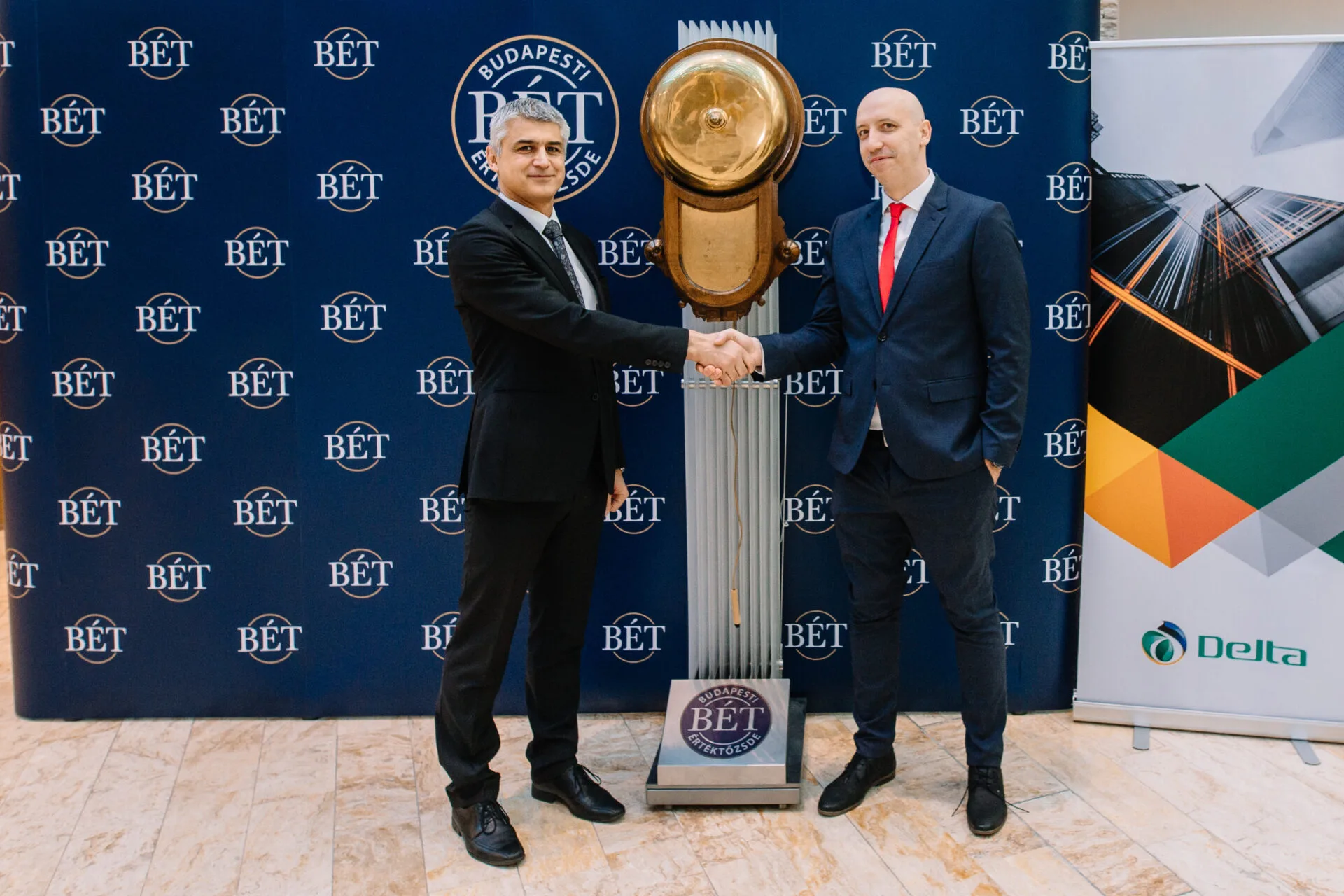
Since my arrival, two series of ordinary shares resulting from capital increases of Delta Group Nyrt. have been introduced to the standard category of the Budapest Stock Exchange's equities market, and one series of interest-bearing shares to the Xtend market.
In April 2026, a further capital increase took place in a private circle through the issuance of „I” series interest-bearing shares; these shares were not introduced to a regulated or other market.
It is important that in the event of any professional or communication issue, prompt correction and clarification take place. Professionalism, compliance with stock exchange expectations and the quality of various investor relations together deliver daily performance. What is a true source of pride is that by now the quality, comparability and content of published materials have improved by orders of magnitude – all of which is naturally the result of teamwork.
Since my arrival, two series of ordinary shares resulting from capital increases of Delta Group Nyrt. have been introduced to the standard category of the Budapest Stock Exchange's equities market, and one series of interest-bearing shares to the Xtend market.
In April 2026, a further capital increase took place in a private circle through the issuance of „I” series interest-bearing shares; these shares were not introduced to a regulated or other market.
It is important that in the event of any professional or communication issue, prompt correction and clarification take place. Professionalism, compliance with stock exchange expectations and the quality of various investor relations together deliver daily performance. What is a true source of pride is that by now the quality, comparability and content of published materials have improved by orders of magnitude – all of which is naturally the result of teamwork.
Were there also examples of errors and crisis situations? How can they be corrected?
There were occasions when a mistake had to be corrected after the event, but the core of the system is that errors can be corrected immediately – either by clarifying an announcement or by publishing a rectification. No problem with irreparable consequences has arisen over the past five years. In the communication of a listed company, it is essential to have accurate, clear and concise disclosures for any events that may affect the Issuer's external reputation and, directly or indirectly, the share price. During communication, continuous contact with the supervisory authority and the stock exchange is of critical importance. Sometimes we receive inquiries that formulate behaviour not to be expected from the issuer or, indeed, expectations that directly infringe legislation. We usually respond to these, where necessary, taking the legal framework into account.
What does overregulation mean today on the Hungarian capital market?
Transactions are becoming increasingly complex, as digitalisation, global market changes and the ever-changing regulatory environment all have an impact, requiring a high degree of adaptability from both sellers and buyers.
Are there any lessons you think are particularly important from your previous experience or from Delta acquisitions?
The capital market is an extremely over-regulated field today, which, following the 2008 crisis, with European legal harmonisation, new supervisory rules and the requirements introduced by the MNB, practically extends to every participant – brokers, issuers, investors. Brokerage activity is subject to unprecedented administrative and informational pressure: investors must be informed in advance, itemised, in writing, over many pages about every risk, customer due diligence must be carried out, every transaction must be reported, etc.
On the issuer side, transparent operation and the continuous disclosure of portfolios, shareholders and free float are mandatory, and compliance logic can easily lead to an administrative setback even because of a poorly conceived rule.
On the issuer side, transparent operation and the continuous disclosure of portfolios, shareholders and free float are mandatory, and compliance logic can easily lead to an administrative setback even because of a poorly conceived rule.
How can a listed company still be made attractive to investors?
Two things are indispensable for this: on the one hand, the market figures and profitability of the core activity, along with performance compared to the sectoral average (scale of operation, turnover, profit margin); on the other hand, a forward-looking strategy and growth potential that the market is willing to „price in”, potentially even with the possibility of exponential growth. The stock exchange does not only price in current results, but also confidence in the future – for this, however, well-founded stories, a well-communicated vision, and compliant yet exciting profitable projects are needed. In my opinion, the latter is particularly difficult in the Hungarian market due to the over-interpretation of regulations, and we still have work to do in presenting the vision.
To what extent can the ESG (environmental, social, and governance) field be built strategically?
ESG is now inescapable, although currently it often appears more as a regulatory compliance and administrative burden rather than a tangible social and corporate benefit. The rules are changing rapidly, and the obligations relating to consultancy, auditing, and reporting entail huge costs. Even more importantly, the mandatory reporting thresholds are being raised by leaps and bounds. At Delta, we have been using a green framework built on a voluntary basis for several years already, and we organise training courses and awareness-raising campaigns.
How do you see the capital market as having changed with digitalisation?
Looking at recent years internationally, the change has been drastic. Dematerialised securities and digital account management are now standard and accessible via a mobile phone. For example, the stock exchange website has had almost the same features for over 10 years and has barely changed. Due to the digital transition, many stock exchange processes, full-scale reporting, data and transaction communication, mandatory transparency and remote data entry have become the norm – reducing the margin for error while also bringing new kinds of challenges. Unfortunately, we often feel that in the digital developments of Hungarian banks and investment service providers, the emphasis is on regulatory compliance and, as the saying goes, they throw the baby out with the bathwater, meaning that programmes do not focus on the customer and enhancing the customer experience.
In my opinion, domestic service providers are not sufficiently developed in the field of digital services and are expensive. The regulator has also contributed to this with the transaction duty tax levied on Hungarian securities.
In my opinion, domestic service providers are not sufficiently developed in the field of digital services and are expensive. The regulator has also contributed to this with the transaction duty tax levied on Hungarian securities.
From a regulatory and liquidity perspective, what is the situation of the Hungarian capital market?
The volume and liquidity of the Hungarian market are low, and in the absence of inclusive growth stories, investor demand is also more limited than in, for example, the Netherlands or Poland. The level of regulation is often excessive, giving market participants little room for manoeuvre – with the exception of high-turnover, expansive companies. Regulatory practice ultimately creates transparency, but it entails significant diversion of resources and a high administrative burden.
Which shares would you buy right now? What tip would you give to investors on what to look at?
As the saying goes, the Hungarian banking system finances a company's past, while the stock exchange finances future opportunities. I cannot recommend a specific security, but it must be said that the longer the investment horizon, the greater the weight equities should ideally hold in a portfolio. It is the consensus of market analysts that almost every sector of the Hungarian equity market is undervalued compared not only to Western European markets, but also to Central and Eastern European ones. This is also the case for the IT sector. A characteristic feature of well-functioning markets is that when an opportunity arises for correction, it takes place. For example, if pension funds were able to return to the Hungarian markets and purchase shares in larger proportions, this could also trigger a significant catch-up growth, or if the unique transaction levy—which is unique because it penalises only Hungarian-issued shares—were to be phased out, that too could once again steer Hungarian investors towards the Budapest Stock Exchange. I worked in the investment field for many years and consider numerous issuers to be suitable investment targets, but one must always start from the premise that every investor's life situation is different, and it is difficult to give advice without knowing that.


