Where digitalisation and business strategy really meet!!
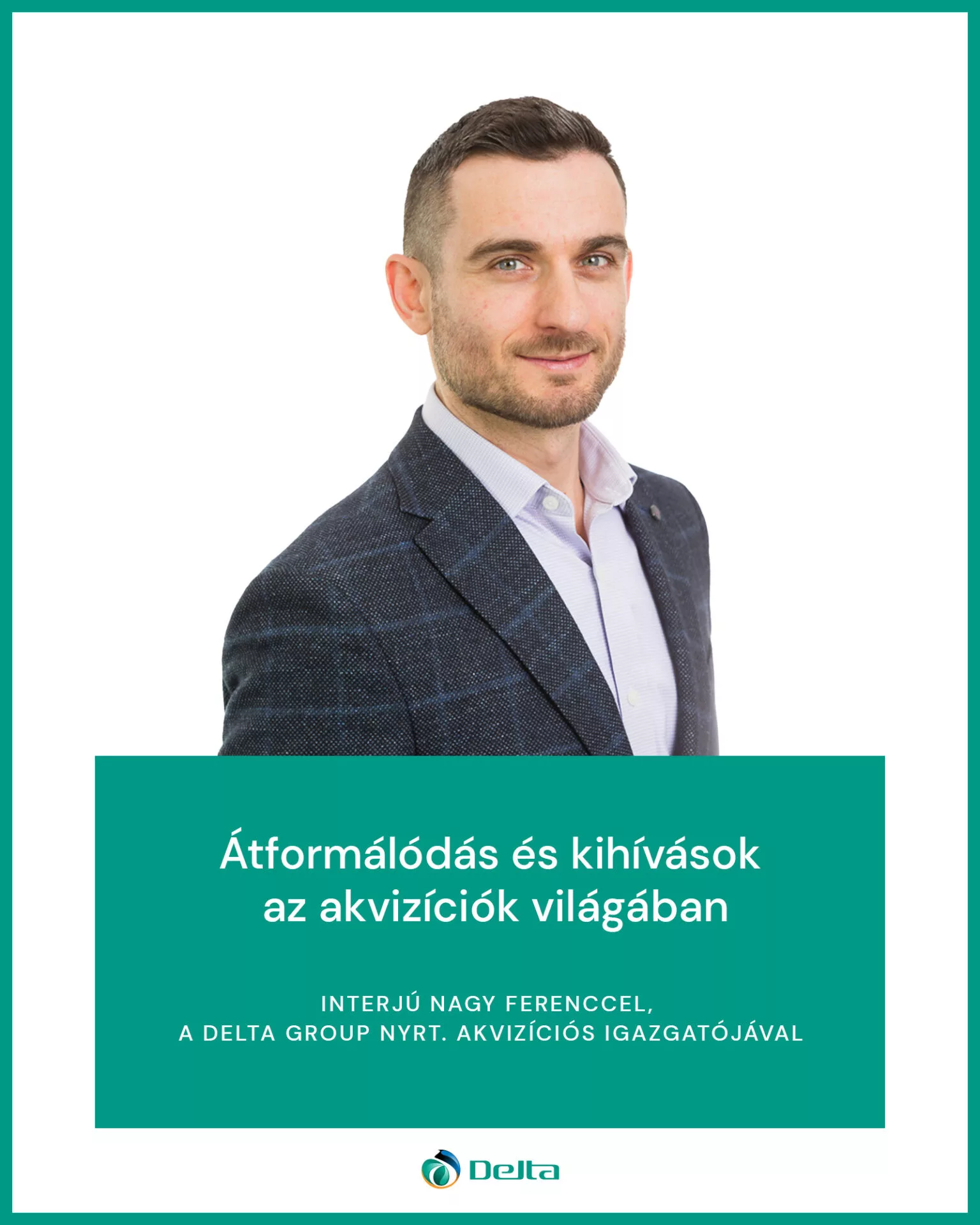
The Hungarian M&A market has seen spectacular growth in recent years, with an increasing number of successful transactions involving medium and large companies. Delta Group Plc. has recently strengthened its market position through several strategic acquisitions, and Ferenc Nagy, Acquisitions Director, has been a key player in these acquisitions, playing an important role not only in the acquisitions but also in shaping Delta's strategy.
For him, an acquisition is more than just a takeover: it is a strategic change process that can radically transform the future, the image and the market position of a company or even a whole group of companies. In our interview, he talks candidly about the behind-the-scenes of acquisitions and how Delta Group thinks about growth.
What does acquisition mean to you?
For me, acquisitions are based on careful preparation and understanding the target companies in as much detail as possible, and identifying value drivers for buyers. During my earlier years as a transaction advisor at EY, I had already experienced that each project is unique and that only through thorough due diligence and a detailed analysis of the risks can an informed decision be made. At EY, I was mainly involved in divestitures, but I also had first-hand experience of how due diligence is conducted, what investors focus on, what criteria they use to evaluate the companies they are buying or how they think about restructuring. I have worked in a wide range of industries, from manufacturing to food and IT, which has confirmed that although the main steps of a transaction are similar, each case is different.
How did your focus change when you came to Delta Group?
Whereas I used to represent the sellers as an external consultant, at Delta I'm involved as a client-side buyer - and although the process is very similar, in many ways it required a change of approach. For me, the project no longer ends with the closing of a transaction, but I am responsible for the subsequent integration of the acquired companies to the right level. A decision does not only affect a specific transaction, but also the future of the whole group.
What inspires a company to think about an acquisition these days?
The most important motivations are to expand the portfolio, to acquire some competence or knowledge and thus strengthen the market position. There are basically two ways for companies to do this: either they develop on their own or they buy into an existing, successful company. Both have advantages and disadvantages - while the former takes longer, the latter is more resource-intensive - we chose the latter. On the one hand, because we have the necessary capital, and on the other hand, time is an important factor for us, which is a critical competitive advantage in the IT market.
Delta's strategy is clearly based on growth, which requires flexibility. We constantly monitor industries and areas within IT where we see growth potential and look for opportunities to combine our team's skills with the resources of the target company and realise synergies following a transaction.
Delta's strategy is clearly based on growth, which requires flexibility. We constantly monitor industries and areas within IT where we see growth potential and look for opportunities to combine our team's skills with the resources of the target company and realise synergies following a transaction.
What does the takeover process look like in practice?
The first step in the process is to identify companies with the right profile, based on a set of criteria developed in line with our long-term strategy. This results in a so-called long-list, which contains the companies' basic economic data and professional competences, giving us the opportunity to narrow down the list if necessary. This is followed by contacting the owners to assess their willingness to sell. If there is openness, negotiating a non-binding offer based on preliminary due diligence is an important milestone in the process, followed by detailed financial, legal, tax and professional due diligence to help understand how the companies operate and identify potential risks. Agreeing on the terms of the sale and purchase agreement concludes the acquisition process, which can take several months from the first step - with serious decisions to be taken at many stages of the process.
The key to success lies in the details - be it company structure, IT systems or human resources.
The key to success lies in the details - be it company structure, IT systems or human resources.
What other considerations apply to an acquisition?
The economic indicators, the activity and the market position are based on the companies' employees, as it is also of utmost importance to us that the employees of the companies feel secure and can identify with the vision of our companies. It is also important that the chosen company fits in with Delta Group's long-term strategy. In particular, we are looking for companies in the fields of industrial automation, application development and IT security that complement our existing services.
Another key consideration is how well the operating model of the acquired company can be integrated into Delta's operations in the long term - it's not about price or speed, but about the potential for sustainable growth.
For these reasons, it is important to us that the acquired companies retain their autonomy, mostly with majority shareholdings, and that we rely on their former management.
Another key consideration is how well the operating model of the acquired company can be integrated into Delta's operations in the long term - it's not about price or speed, but about the potential for sustainable growth.
For these reasons, it is important to us that the acquired companies retain their autonomy, mostly with majority shareholdings, and that we rely on their former management.
As an acquisition director, to what extent can you delegate your tasks?
In certain situations, my personal presence is essential, especially when strategic decisions are taken or unexpected problems arise. It is important to build a relationship of trust with the other party, as we are looking for solutions that benefit everyone in the long term. At the same time, I am fortunate to work with an excellent team - financial, legal and operational - so I can delegate many tasks with a clear conscience.
How is the world of acquisitions different today than five or ten years ago?
Transactions are becoming increasingly complex, as digitalisation, global market changes and the ever-changing regulatory environment all have an impact, requiring a high degree of adaptability from both sellers and buyers.
Are there any lessons you think are particularly important from your previous experience or from Delta acquisitions?
The biggest lesson is that you can never sit back during the process, because there are many issues that may arise before the transactions are closed and need to be resolved. Even with thorough preparation and due diligence, you cannot be complacent and it is important to strike a balance between quick decision-making and thorough analysis. In addition, flexibility is essential: every company is different and one-size-fits-all solutions will not work in every case.
That's why I love this profession - there's always room for learning and development.
That's why I love this profession - there's always room for learning and development.